
LaGrange Directory Runs on Record
The verified city directory trail begins with a special reconstruction for May 1929, then resumes in a recurring print and microfilm run after World War II. A Gale and ProQuest author index supplies the firmest year list. A separate repository inventory identifies R. L. Polk as publisher for several later editions. These sources prove that listed volumes survive somewhere, but they do not prove that every missing year was never issued or that each title sits on a local shelf today.
| Collection | Documented years | Known keeper or publisher | How to reach it |
|---|---|---|---|
| Reconstructed Black-resident directory | May 1929 | FamilySearch Library; Anglin and Franco | Cataloged book and digital-version link |
| La Grange city directories | 1946, 1948, 1950, 1952, 1954, 1956, 1958, 1960 | Gale/ProQuest microfilm index | Microfilm record; digitized copies are reported elsewhere |
| Later LaGrange directories | 1969-70, 1972-73 | Gale microfilm; R. L. Polk verified for 1973 | Print or microfilm repository access |
| Troup County Rural Residents Directory | 1977-79, 1982-85, 1986/87, 1988 | Gale microfilm; Polk named for several editions | Useful beyond older city limits |
| Latest verified print range | 1989, 1990, 1991 | R. L. Polk; 1990 appears in a separate inventory | Repository inventory or microfilm request |
The gaps matter. The verified early run skips odd years, and there is a long break between 1960 and 1969. Never turn those gaps into a claim that publication stopped. Ask the holding library for the exact reel, title, and year, and inspect the volume for a street section or householder index.
LaGrange's Recovered 1929 Directory
A newly cataloged reconstruction makes 1929 unusually important. Phillip B. Anglin and Zoe Franco assembled about 1,700 Black LaGrange residents who were identified by the period's segregated language. The work records names, spouses, occupations, and street addresses. That focused recovery helps correct the omissions and separation common in older mainstream directories. The historical title should be explained in context, not used as a modern label.
The FamilySearch Library catalog lists the work as an electronic reproduction and a 219-page book under call number 975.8463/L1 E4a. A digital-version link appears in the catalog, though account and image access can vary. Pair its entries with the 1930 census, Mulberry Street Cemetery evidence, newspapers, deeds, and church collections. Each source tests whether two similar names belong to the same family.
Search tip. Try both “La Grange” and “LaGrange,” plus initials and surname variants, because catalogs and old print use both city forms.
Read a LaGrange Directory Entry
Read only the fields printed in that volume. The real 1929 entry quoted by Troup County Archives names Robert M. Young as a farmer and proprietor of Little Lake Lahleet. It confirms a person, an occupation, and a business role. It does not verify a spouse, house number, telephone, widow notation, or ownership mark in that sample.
| Person | Robert M. Young |
|---|---|
| Work | Farmer |
| Role | Proprietor of Little Lake Lahleet |
| Edition | May 1929 source reconstructed in 2025 |
| Broader fields | Names, occupations, spouses, and street addresses across the collection |
Photograph or note the front matter before decoding short forms. Marks can differ by publisher and year. An occupation can link a person to other records, but it does not prove an address beyond that edition's canvass date.
- Criss-cross directory
- An address-first section arranged by street and house number. Check its presence volume by volume.
- Householder index
- A street-order list that may name the person associated with each address.
- Abbreviation key
- The volume's guide to initials, work terms, residence marks, and other short forms.
LaGrange Records at Taylor Library
Troup County Archives and its Taylor Research Library are the local research hub. The Archives is the official repository for transferred records from Troup County, LaGrange, Hogansville, and the school system. Its holdings include more than 500 manuscript collections, about 40,000 boxes, 300,000 documents, thousands of family files, and more than 30,000 photographs dating from the 1850s. Online finding aids are guides, not proof that the papers have all been scanned.
The Archives research service recommends an appointment so staff can pull material in advance, although drop-ins are allowed. Handheld cameras and portable scanners may be used under staff rules. Requests are handled in order, with an effort to reply within five business days. Research hours are Monday through Friday, 9 a.m. to 5 p.m., at 136 Main Street. The minimum request is $5; photocopies are 10 cents per page, certified copies $10, and notarization $2.
Ask for a person, year range, address, and record group. Staff can then test family files, newspapers, manuscripts, court records, photographs, or city files without treating a broad surname as one household.
Map LaGrange Directory Addresses
City directories name people. Sanborn fire-insurance maps describe the built block around them. The University of Georgia lists LaGrange sheets from 1895, 1900, and 1911, with four, six, and twelve sheets respectively. They show footprints, materials, uses, outbuildings, and street layout, but usually do not name occupants.
Review the UGA LaGrange Sanborn holdings before matching an old address to a new parcel.
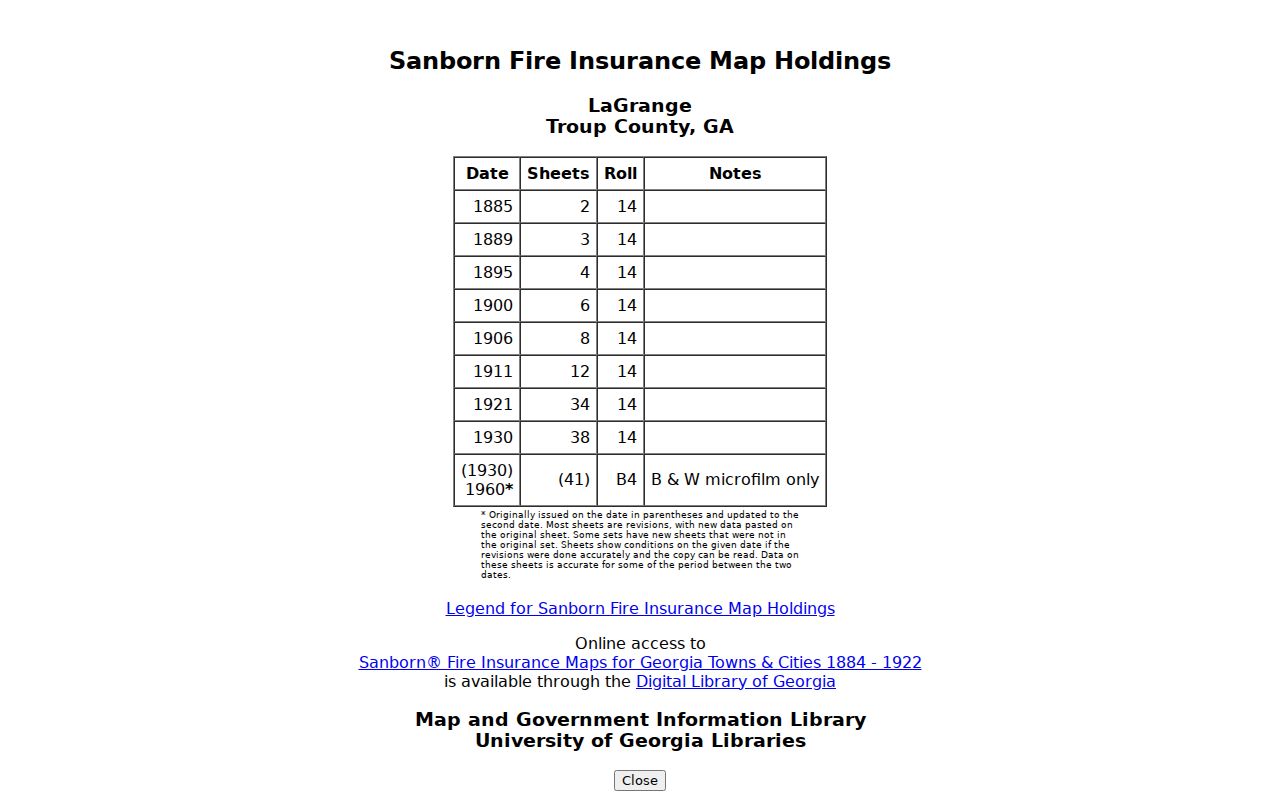
The year and sheet counts help select the right map before searching a directory entry. Morgan Street and New Franklin Road show how one location may have different labels. Building form and block position can preserve continuity when the street name shifts.
Fill LaGrange Directory Gaps
Newspapers bridge years with no verified city directory. Georgia Historic Newspapers provides a free LaGrange run from 1843 through 1914. It includes the La Grange herald, the much larger La Grange Reporter run, the Daily bulletin, and The graphic. Search names, initials, streets, firms, marriages, deaths, visitors, church events, and legal notices. OCR can misread old type, so inspect the page image before recording a fact.
Troup County Archives also says local newspapers from the earliest county printing have been microfilmed, digitized, and indexed. That local index may cover items outside the public online span. A newspaper mention is best used to explain a move, death, work change, or family link first found in a directory.
LaGrange City Directory Milestones
The surviving run reflects changes in whom publishers tried to reach. It also shows why no single shelf can stand for every LaGrange household.
| Year or span | Collection milestone |
|---|---|
| 1929 | Source behind the recent reconstruction of about 1,700 Black residents |
| 1946-1960 | Recurring even-year La Grange volumes in the verified reel index |
| 1969-1973 | Later city volumes, with Polk verified for 1973 |
| 1977-1988 | Rural titles broaden coverage beyond older urban canvasses |
| 1989-1991 | Latest verified range, not a proven final publication date |
This is a publication timeline, not a residence timeline. A first appearance means a person was recorded by that edition. A last appearance marks only the end of the observed interval.
LaGrange Mill Families in Print
Formal directories are not the only name-rich source from LaGrange's textile era. Callaway Mills published the Callaway Beacon from 1949 through 1968. Troup County Archives describes its employee profiles and private-life announcements as rich genealogy evidence. A profile may preserve a photograph, a relative's name, a community event, or a name variant during years when the printed directory trail is sparse.
Use the magazine as a companion source. Begin with a directory match near the same date, then search the magazine for the person, close relatives, and the work site. A company story can explain why a family appeared in LaGrange, while a later announcement may point toward marriage, death, military service, or another city. It should not replace the address evidence in the original entry. Cite the issue and page, then confirm family statements through newspapers, vital records, census schedules, or cemetery files.
Organizational and business manuscript collections at Troup County Archives add another route. Staff may connect a mill newsletter, club record, company photograph, or family file to a directory name. Compiled family files are leads. Deeds, court papers, marriage records, and newsprint remain the stronger proof.
Trace Family Through LaGrange Directories
Follow one household across the available years, then use independent records to explain each change. Every citation should include the edition, page, exact spelling, address, and all short forms.
- Begin with the surname in a known year. Record middle initials, spouse, work, and address exactly.
- Move to the next available volume in each direction. Treat first and last appearances as a range.
- Check a street section only when that edition contains one. Note nearby homes and business addresses.
- Compare the closest federal census, including the released 1950 schedule, and use deeds or probate to test links.
- Search newspapers, cemetery registers, church records, and obituaries when a person vanishes from print.
Absence has many causes. A person may have moved during the canvass, lived beyond the boundary, been missed, declined a listing, or appeared under a spouse or variant spelling. Rural titles are especially useful from 1977 onward. For modern address records, use the LaGrange street directory.